It begins as one point of light, breathing in the dark. Touch it, and it unfolds. Branches reach, signals travel along them, small lives arrive and follow the light, weather moves through, and every place you touch is remembered as a constellation of your own making. You do not build the world. You breathe on it, and it unfolds in the direction of your warmth.
Some of the grown points hold whole further worlds, and each of those begins, again, as a single point of light. You can dive in, and in, and in. And when a world has unfolded far enough and you step all the way back, the thousands of moving pieces gather into one golden disc, then condense into the very point you first met, while all the layered sound settles into a single chord.
Complexity is simplicity unfolding,
and simplicity is complexity seen whole.
How the worlds grow
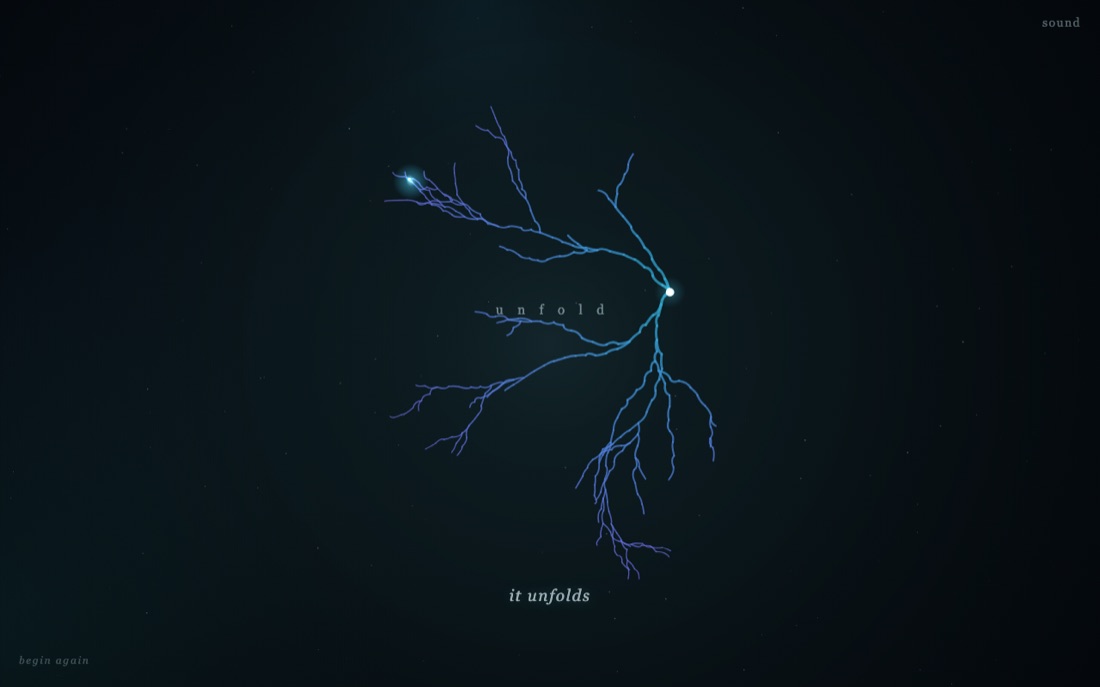
Nothing in the piece is placed by hand and nothing is a stored picture. Every world grows live from an algorithm borrowed from living systems, chosen for that world by its seed. Some spread like the veins of a leaf, claiming scattered ground as they reach it. Some stand and lean toward the light like trees, their limbs thinning at every fork the way Leonardo da Vinci observed in real wood. Some wander and connect like mycelium under the soil.
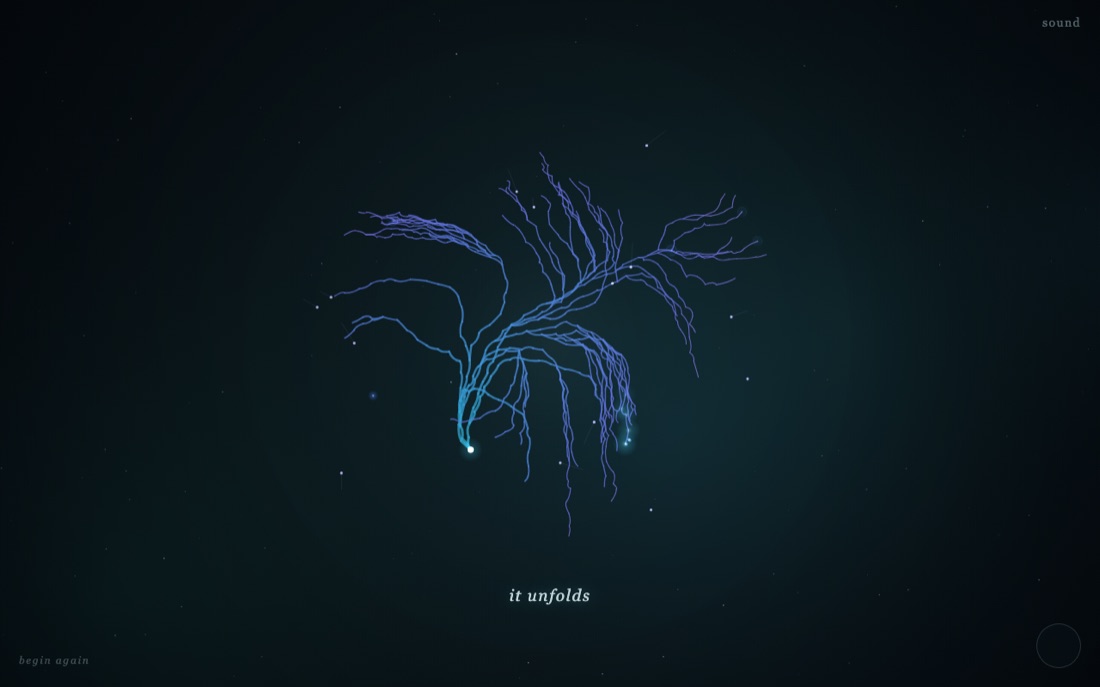
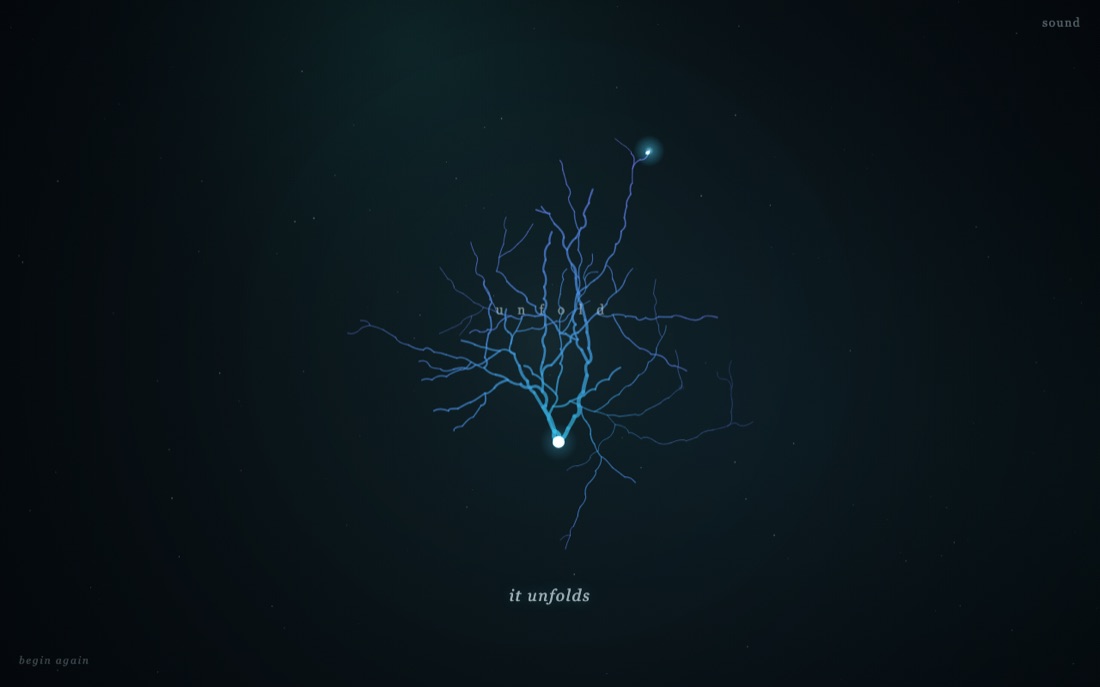
Each visit mints a new world with its own name, and any name regrows its world exactly, down to the first forty branch positions. So a world can be left, returned to, and found where you left it. Its temperament, how eagerly it branches, how far it reaches, its colour and its weather, is drawn once from the seed, so each world has a character rather than a set of sliders. Variation and reproducibility stop being opposites, for the same reason they are not opposites in nature: one simple law meets different ground each time.
Distance is the instrument
The thing you control is not a cursor so much as how close you stand. Come near and the systems separate: single chimes, single travelling pulses, single small lives. Step back and the same running systems merge, into one silhouette to the eye and into one chord to the ear, because every layer of the synthesized sound has its volume tied smoothly to how far away you are. The simplicity is not the start of the piece. It is what the piece looks like from anywhere far enough away, and from anywhere deep enough in.
Why it exists
Everyone is told the cure for a complicated life is subtraction: delete, simplify, strip back. unfold argues the opposite, from inside an experience rather than in an essay. The complicated thing you are inside of was, all along, one simple thing seen from very near. Complexity is not defeated or cleaned away at the end. It is recognised. The final disc is made of every node you grew, every world you visited, every place you touched, arranged at last so the eye can hold all of it at once.
Writing about unfold? Download the press kit (artist statement, stills, AI disclosure), or the door is hello@muplu.com.
How it was made. unfold runs as a single self-contained file: no engine, no libraries, no network, no recorded media. Every pixel is drawn and every note is synthesized live by code written for this one piece. It was conceived, authored and directed by Nicola Harvey and built with an AI coding agent as the instrument, every behaviour specified, tuned and verified by her. It contains no generated images and no generated audio. The growth algorithms are drawn from published models of natural morphogenesis: space colonization (leaf venation), phototropic branching with Leonardo da Vinci's branching rule, and golden-angle phyllotaxis.